Field Notes · Divorce
Divorce in Dubai
Money. Time. Identity. A straight-talking, lived-experience guide to what divorce in Dubai actually costs - and the part no lawyer will write for you: rebuilding afterwards.
Too long to read now? Email us for a copy →
or write to hello@fraserpractice.com
Quick caveat before we get started - there's amicable and there's contested. There's children, pets, property, and assets to be considered. Even if amicable, fair division of property, assets, and custody can quickly turn an amicable split into a long, drawn-out contested process.
So before you read a single number below, understand the real variable isn't the law. It's the people, the depth of the pockets, and the staying power.
This piece comes in two parts. Part One is the process - what divorce in Dubai actually costs you in money and time, across three paths. Part Two is the part nobody sends an invoice for: starting over, and rebuilding your life when it's all said and done.
Part One
The Cost and the Timeline
The Three Paths, at a Glance

Which road you're on usually comes down to a single question.
How Much Does an Uncontested Divorce Cost in Dubai?
Path 1 - the clean break. Not married long. No kids, pets, or assets. Not contested. Amicable. Rare in reality.
You both realise there's been a mismatch - and wish to move on as quickly and painlessly as possible, with no desire to fight or drag things out.
The route here is Dubai Courts together: draft the agreement, get your documents translated, pay the necessary court fees, attend on the day required, and finalise on the spot. Depending on the season and the court system's bandwidth, this could take anywhere from 1 day to about 2 weeks. Absolute maximum cost will be around 5K AED.

One thing worth checking: that the divorce - the decree nisi, as it's called in UK law - is stamped and attested before you move on. This helps in your future life and keeps you in the new future you envisioned, rather than always being dragged back into each other's lives for whatever reason.
The key here is a clean break - and being free to move forward, unburdened.
How Much Does an Amicable Divorce With Kids and Assets Cost?
Path 2 - amicable, but with more to divide.
The first and most sensible decision at this point is to get a mediator - before you both go and appoint lawyers. That is the fastest way to spending a fortune for no reason other than fees that could often have been avoided.
If you both agree you want it amicable, you should both be willing to mediate the details before the lawyers. Go in with an open mind.
The art of a good compromise is that both parties feel pissed off with the result. Within that outcome is the likelihood of a fair one. If either party is losing more than their fair share, the long-term prospect of co-parenting is a tenuous proposition at best.
Important point at this stage: it's easy to think if I'm lenient on the details now, they'll be lenient later. This is a mistake. The process will bring bitterness to the surface, and once a deal is finalised it's next to impossible to change. You may be told otherwise - but I have seen this in action.
Stand your ground on the final agreement. You can decide to be lenient later - do not be lenient in the agreement, regardless of what the other party is saying.
Assuming mediation has gone well, both parties will appoint lawyers. A fair assumption is the lawyer drafts all agreements and translations, runs the process through the courts, and ensures division of assets and custody are settled - around 50K per party.
Here's the catch: you can end up paying 50K for the mediation stage, then another 50K for the court part. That's exactly why you settle the draft agreement in advance, through mediation, away from the lawyers.
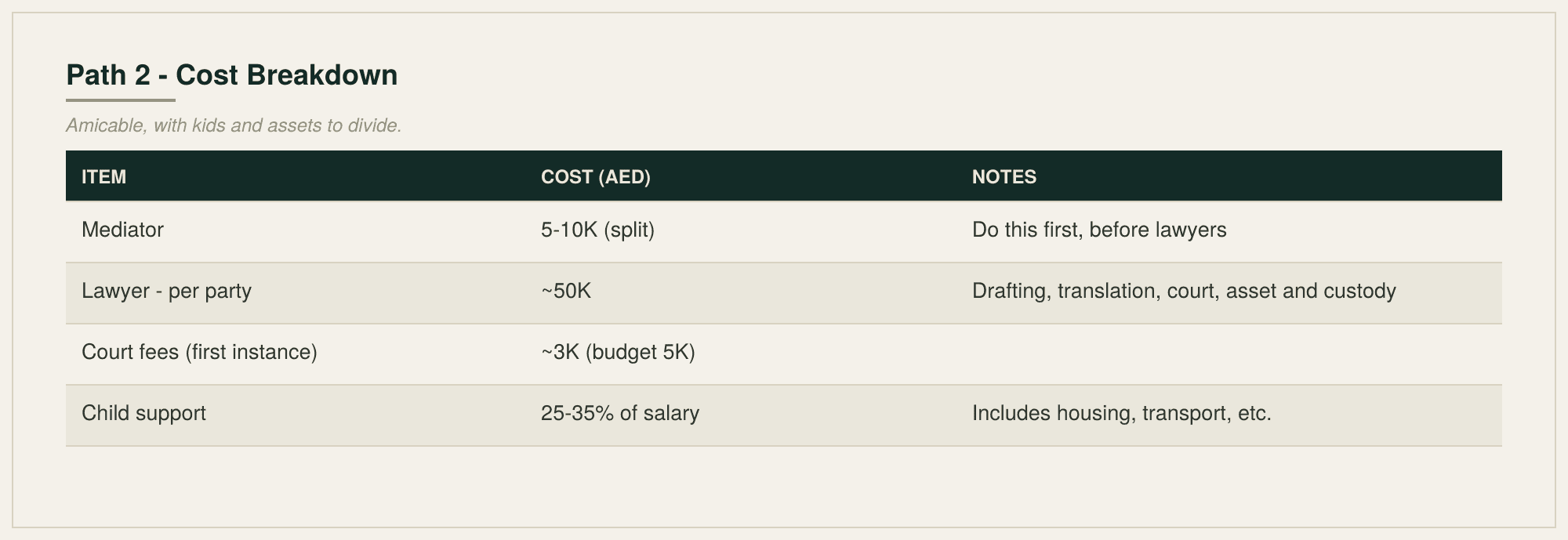
A good mediator runs somewhere in the region of 5 - 10K max, split between the parties. Settle it there, and you avoid paying a lawyer 50K to do the same job.
How Much Does a Contested Divorce in Dubai Cost?
Path 3 - contested, with kids, property, and everything in between.
This is really the most horrible outcome for everyone involved - not least the children, who in some cases become weaponised against a parent in the hope of drawing as much money out of the other side as possible. Sadly, this does happen - it's a global pattern rather than something specific to the UAE, and it's often made worse by an adversarial process that rewards conflict.
Legal fees tend to run around 50K per "thing" - so the mediation stage, 50K; running the court process at first instance, another 50K. This is where it becomes challenging. Where mediation fails, the decision goes to the courts - and the courts rarely leave any party delighted with the outcome. So more often than not, you're looking at an appeal. And surprisingly, that's another 50K.
And the pattern emerges: an adversarial process can keep you on the ferris wheel of bitterness for as long as possible, because every dispute generates another round of fees. There is never any guarantee of a fair result. Historically, many fathers perceive custody and financial outcomes as favouring mothers - though outcomes can vary depending on the individual facts of the case.
This is where it's critical to understand what you may be in for - and the bad actors come in both kinds.
There are men out there who will go to the ends of the earth to avoid their responsibilities. Hiding or under-declaring income and assets so support is calculated on a fiction. Stalling, delaying, and appealing not to win but to financially exhaust the other side until they give up and settle for less. Moving money - or themselves - offshore to dodge obligations entirely. Cutting off access to joint funds mid-proceedings to apply pressure. Dangling the kids as leverage for a cheaper deal, then going quiet on their own children the moment it stops being convenient. I have seen this. It is abhorrent - but there's a common thread across the globe: certain types behave certain ways - and we're not going to solve it here.
Conversely, and equally abhorrent, are those who appear to relish the pain and suffering they can cause their ex - usually in the guise of restricting access to the children and/or extracting as much money as humanly possible. Once that behaviour becomes habit, access to your own child can become negotiable on someone else's whim. I don't know the numbers on this, but I'm confident this very reality has ruined many a good soul.
The point isn't men versus women. It's that a contested divorce hands enormous leverage to whichever party is willing to weaponise it - the children, the money, the delay - and there are plenty on both sides who will.

Can a Divorce Really Cost Over AED 1 Million?
Yes - and here's how the maths gets there.
You can have divorce, asset split, custody/visitation, and child support as four separate points. Once the initial judgement is passed, each appeal becomes a separate case.
So you appeal custody - one case. Appeal child support - separate case. Appeal property division - new case. Each could end up in the high court at ~225K a piece, running over multiple years, and you're well in excess of 1M AED on lawyers and court fees alone.
The Process - Where It Can Go

How Long Does a Divorce Take in Dubai?
It depends entirely on the path. An amicable, no-complications split can be done in a day to two weeks. Add children and assets and you're into weeks or months, mostly governed by how fast you settle the agreement. Contested, with appeals, runs into years - mine has run five and counting. The single biggest lever on the clock is whether both parties stay out of the adversarial process.
My Own Situation
I speak only from my own experience - which has so far taken five years as I fight for fair and reasonable access to my child, so I can be the best father possible.
I pay 25% of my monthly salary in child support, and my cases have gone all the way to the highest court in the land.
Court of the first instance typically costs around 3K, high court fees can range up to 10K - and that's four separate cases: the original plus three appeals to ever-higher authorities. For a single matter, it can be around 25K in court fees and 200K in lawyers.
That's what nobody tells you going in.
I never imagined that five years on I'd still be filing cases. You assume, naively, that there is a finish line - a single hearing, a single decision, and then life resumes. There isn't, not when it's contested. There is only the next point, and the next.
I assumed one appeal would settle it. It doesn't work like that. A judgement you don't like isn't the end of the road; it's the start of a new road, with its own fees, its own waiting, its own toll.
And I didn't understand - not really - that custody, support, and property could each become their own separate fight. You can win one and still be standing at the start line of the next three. The system doesn't hand you a clean, single result. It hands you a series of doors, and behind each is another invoice.
What I've learned is that these processes don't reward who's right. They reward who can keep going - who has the funds, and the staying power, and the reason to. For me the reason has never wavered: being present in my child's life. But I've watched the cost of that resolve, financially and emotionally, and I understand completely why people give up. Many do. Something gives first - it's either the money or the will.
I don't say any of this to frighten you. I say it because I'd have given a great deal, five years ago, for someone to tell me plainly how far it could go - so I could have chosen my battles, braced for the marathon, and protected myself in the ways I hadn't thought to.
I don't think anyone walking into these situations fully appreciates how far they can go. What's rarely limitless is funds, or staying power. Decide which you have, then decide the best path. Option 1, all day, every day, for me.
Part Two
The Aftermath: Starting Over
Eventually every court hearing ends. The emails stop. The lawyers disappear. The house goes quiet.
That's when the real work begins.
You can budget for the lawyers. You can plan for the court dates. What you can't put a number on is the part that comes after the paperwork is stamped - when the fighting stops and you're left standing in a life that feels unfamiliar. That's the bit nobody warns you about. So, let's talk about it.
It's a Rebuild, Not a Restoration
Starting over isn't a single act. It's a slow, unglamorous rebuild - of your routine, your identity, your finances, your idea of the future. And the first mistake people make is trying to get their old life back. That life is gone. Some of it you may not even want back. The job isn't restoration; it's building something new that fits the person you are now - which means deciding, deliberately, what to keep and what to leave behind.
The cruelty of it is that everyone expects you to be either devastated or relieved, and you're usually both, several times a day. That's normal. It doesn't mean you're failing at recovering.
Why It Hits the Way It Does
Three things are happening under the surface, and naming them helps.
The first is that you're grieving a future, not just a person. You didn't only lose a partner - you lost the version of your life that had them in it: the holidays, the growing old, the shared story you'd already half-written. That future was real to you, and grieving it is legitimate. Skipping that step doesn't work.
The second is identity collapse. Marriage quietly shapes how you see yourself - as a spouse, as half of a unit, as a parent inside a particular family shape. When it ends, "who am I now?" isn't a dramatic question. It's a literal one. You have to rebuild a self that stands on its own two feet.
The third is the loss of structure. Relationships organise time, money, decisions, and roles, mostly invisibly. Pull them out and the scaffolding of ordinary life falls away. A lot of what feels like weakness in those early months is really just the absence of structure, mistaken for the absence of strength.
It tends to land hardest during the unstructured hours that used to be shared. You don't recognise your own calendar. The silence is loud. And the practical admin of a separated life - money, logistics, two households where there was one - piles on top. All of it is normal.
What the Rebuild Actually Looks Like, Month by Month
Nobody can promise you a timeline. But there is a rough shape most people move through, and seeing it laid out helps you place yourself on the map.
Month 1 - survival. Don't aim for thriving. Aim for sleep, food, and getting through the day. Decide nothing permanent. Lean on whoever you've got.
Month 3 - structure. The shock has dulled. This is when you rebuild routine deliberately - work, movement, socialising. Motivation may not have returned yet; build the habits anyway and it follows.
Month 6 - identity. You start to feel like a person again rather than the wreckage. Old interests resurface. You begin making small choices that are yours.
Month 12 - direction. The big questions you were too raw to answer early on - where to live, what you actually want - can finally be faced with a clear head. This is where genuinely new chapters get written.
Move backwards some weeks. Everyone does. The curve is never a straight line - it loops back through anger and loneliness before it climbs. That's not relapse. That's the shape of the thing.

The Mistakes That Keep You Stuck
A few traps catch nearly everyone. Spot them early and you save yourself months.
Rushing to fill the space. New relationship, new city, big purchase - anything to avoid the silence. Usually it just delays the actual processing, and sometimes adds a fresh complication on top.
Defining yourself by the divorce. For a while it's the headline of your life. It shouldn't become the whole story. You are not your worst year.
Doing it all alone. Isolation feels like control, but it's where the worst spirals happen. The people who recover well are almost always the ones who let a few others in - friends, family, a professional, a group.
The Decisions That Come With Starting Over
The same discipline from Part One applies here - run the big calls through a simple filter rather than your mood on the day.
Stabilise first, optimise later. Get to safe and functional before you chase ideal. Survival mode is not the place for big bets.
Separate urgent from permanent. Where to sleep this month is urgent. Where to live for the next decade is not - don't let one masquerade as the other.
Run every option past your non-negotiables. For me that was always access to my child. Name yours, and let them break ties between options.
Decide for now, with a review date. Most decisions don't need to be forever. "Right for the next six months" is a perfectly good answer, and it gets you moving.
When to Get Help
There's no shortcut through grief, and anyone selling one is selling something. But if the weight is more than you can carry - if you're not sleeping, not functioning, or not safe - that isn't a failure of willpower. A good therapist or your doctor is the right call, and a sensible first move, not a last resort.
How Do I Financially Survive a Divorce?
The cost tables above are what the process takes from you. This is how you protect what's left while it's happening. None of this is regulated financial advice - it's hard-won common sense.
Five Financial Rules During Divorce
Don't sell assets emotionally. Fire-selling a property, a car, or investments to "be free of it" or to fund the fight almost always costs you more than the relief is worth. Slow down.
Build a six-month cash reserve. Legal processes run long and unpredictably. A buffer is the difference between negotiating from strength and settling because you're broke.
Track every legal invoice. Fees accumulate quietly across stages and appeals. Log every one. It keeps your lawyer accountable and your decisions informed.
Avoid revenge spending. The new car, the blowout trip, the "I deserve it" splurge - they feel like reclaiming control. They're usually just transferring the damage from your heart to your balance sheet.
Don't make investment decisions during proceedings. Your risk judgement is compromised when you're under this much stress. Park big financial moves until your head is clear and your settlement is final.
Get these five right and you give yourself the one thing a contested divorce tries hardest to take: staying power.
Frequently Asked Questions
General guidance based on experience. Legal specifics change and depend on your circumstances - confirm anything you'll rely on with a qualified UAE family lawyer.
How long does a divorce take in Dubai?
An amicable, uncomplicated divorce can finalise in a day to two weeks. With children and assets, weeks to months. Contested, with appeals, it can run for years.
How much does a divorce lawyer cost in Dubai?
In my experience, fees often run around AED 50K per major stage - the mediation/agreement stage, then the court stage, then each appeal. Costs vary widely by firm and complexity.
Should I get a mediator or a lawyer first?
A mediator, almost always. Settling the agreement through mediation before lawyers get involved is the single biggest way to control cost - and to protect any future co-parenting relationship.
Is mediation or reconciliation mandatory?
Family cases here typically begin with a court reconciliation/family-guidance stage before the dispute proceeds. Whether and how it applies to you depends on your circumstances and the current rules - confirm with a family lawyer.
How much is child support?
Commonly in the region of 25-35% of the father's total salary, including housing and transport allowances - though the figure depends on income, the child's needs, and the court.
Can fathers get custody?
Custody and guardianship are treated differently under UAE law, and outcomes turn on the specific facts, the child's age, and the governing law. Fathers do secure meaningful arrangements - but this is exactly the area to take proper legal advice on rather than rely on assumptions.
Can my ex stop me seeing my child?
In practice, access can become a flashpoint, and obstruction does happen. Where it does, enforcement runs through the courts. Document everything and get legal support early.
What happens to property and assets?
Division depends on what law governs your divorce and how assets are held. Since 2023, non-Muslim expats can use the UAE's civil framework, and expats may be able to apply their home country's law - which can materially change the outcome.
Does the new civil law apply to expats?
Yes - since 2023, non-Muslim residents can have personal status matters, including divorce, handled under civil law, and expats may apply the law of their home country. Confirm how it applies to your nationality and situation.
Can I represent myself?
It's possible for a straightforward, amicable case. Once it's contested - with children, property, or appeals - self-representation is risky, and most people need a lawyer.
Why does it get so expensive?
Because an adversarial process bills per stage and per appeal, and each contested point can spin off into its own case. Cost is driven less by the law than by how much both sides are willing to fight.
Is it true outcomes favour the mother?
Many fathers perceive that custody and financial outcomes lean that way. In reality, outcomes depend on the individual facts and the governing law - which is why specific legal advice matters more than the rumour mill.
The Takeaway
Divorce costs you twice. Once in money and time - and on that front, the cheapest, fastest, healthiest version is the one where both parties stay off the ferris wheel: mediate first, settle the agreement away from the lawyers, hold firm on what's fair, protect the clean break.
And once in everything the invoices don't capture - the future you grieved, the identity you have to rebuild, the structure you have to put back by hand. That second cost is the one that actually decides how the next decade of your life feels.
Decide what you have. Decide the path. Then go and rebuild - on purpose, not by accident.
One day this won't be the biggest thing that's ever happened to you. One day it'll simply be something that did. That's the day you stop surviving and start rebuilding.
Worth Reading
Building a Life Worth Living - Marsha Linehan. Rebuilding after upheaval.
Crucial Conversations. For co-parenting communication that doesn't escalate.
The Psychology of Money - Morgan Housel. Steadying the financial side.
This article is general, experience-based guidance - not legal, financial, or therapeutic advice. Court fees, support percentages, custody rules, and procedures change and vary case by case; the UAE updated its personal status laws recently, so verify current figures and rules with a qualified UAE family lawyer before acting. If you're struggling, please speak to a professional you trust.
The full guide
Want the whole thing in one place?
No forms, simply mail us and we'll send the full guide straight over. Tell us where you're stuck if you like, and we can start the conversation.
Email us for the guide
or write to hello@fraserpractice.com